Our Lepola School
On this page, we provide more information about Lepola School and its practices.
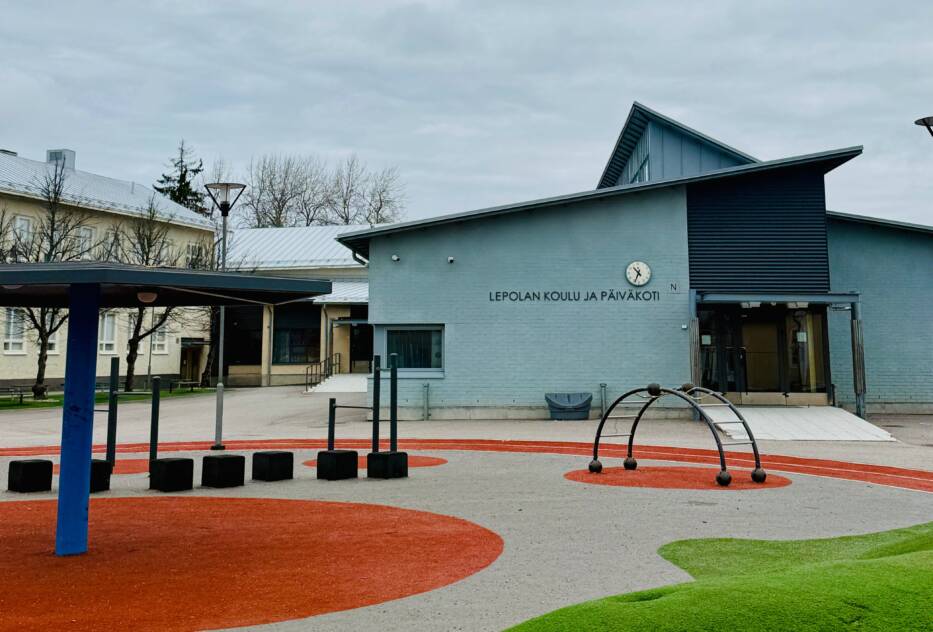
Lepola School’s operating principle
Lepola School is an open and encouraging environment for growth and lea ing that values hard work. At school, pupils lea to work independently and in different groups while respecting others. The school uses appropriate and mode teaching methods and tools. The school supports the mental, physical and social well-being of its pupils.
The pupil’s own actions and responsibility for their own lea ing are considered important, taking into account the pupil’s individual lea ing conditions. The aim is for the pupil to recognise their own strengths, trust themselves and strive for their own future.
The school values cooperation between home and school and supports guardians in their educational work.
Communication with the school
The best way to contact teachers is via Wilma. The email
addresses of teaching staff are in the format etunimi.sukunimi@tuusula.fi.
See Lepola School’s detailed contact information.
Lepola School Parent Information
The(switch to another service) Lepola School Parent Information Pack (switch to another service)contains information about our school’s activities and practices, as well as the school rules.
School lessons and breaks
8:15–9:00 a.m. Lesson 1
9:00–9:45 a.m. 2nd lesson
9:45–10:15 Break
10:15 a.m.–12:00 p.m. Lessons 3 and 4 (includes lunch)
12:00–12:15 Break
12:15–13:00 Lesson 5
13:00–13:15 Break
13:15–14:00 Lesson 6
2:00–2:45 p.m. Lesson 7
If a pupil’s school starts at 10.15, they can come to school as early as 9.45 for a long break.
Due to celebrations or other special activities, an adapted timetable may be used during school days.
School working days and holidays
Afte oon club
Lepola School runs an after-school club for children in grades 1–2. The after-school club is open on school days from 12 noon to 4 p.m. Iina Tiihonen and Sirpa Salo are the supervisors of the club, and the instructors are school assistants who work at Lepola School.
Information about the activities and application process for afte oon clubs in the municipality of Tuusula can be found on the afte oon club activities page.
The objectives of the afte oon club are:
- provide safe, supervised and guided activities for pupils in grades 1–2
- enables parents to work
- support the educational work of schools and homes
- make the child feel safe when an adult is present, someone who will listen and also give a hug if comfort is needed
- teach children to take care of and take responsibility for their homework
- teach children to take care of their own belongings
- teach good manners, teach table manners
- teach them to consider others and form friendships – friends are not left alone.
Report absences immediately
Please report any absences immediately.
Sick leave must be reported immediately to the class teacher via Wilma.
Wilma can also be used to apply for additional leave, if necessary. This is done via the Applications and Decisions tab in Wilma. The class teacher can grant leave for a maximum of three days. Applications for longer periods of leave should be addressed to the head teacher.
When a pupil is absent from school, they must find out for themselves what homework and schoolwork has been set during their absence, for example by asking their classmates.
When applying for leave of absence, guardians should note that pupils are obliged to study during the extra time off they have been granted. Pupils must complete any schoolwork assigned during the leave and study independently or under the supervision of their guardian. The teacher may not necessarily provide a detailed list of assignments for the additional holiday, but may, for example, inform the pupil of the topics that will be studied at school during this period. The guardian is responsible for ensuring that the pupil completes the assignments. The pupil agrees with the teacher on when to take any exams during the holiday. As a rule, no remedial teaching is arranged for the pupil due to the holiday.
Action plan for worrying absences
In the case of absences that give cause for conce , the class teacher or supervisor is obliged to discuss the matter with the pupil and their guardian. An individual student welfare team (multidisciplinary team of experts) may be assembled to deal with the matter. The team is assembled from persons relevant to the student’s case with the consent of the student and/or their guardian.
A worrying absence is defined as follows:
A. Repeated unexplained absences due to illness exceeding twenty 45-minute lessons per month, or absences recurring according to the same patte .
For example, if a pupil is repeatedly ill for one or two days a week, this should be addressed.
B. Unauthorised absence from individual lessons or the entire school day, even if the pupil remains on school premises. The absence has not been approved by the guardian or the school.
C. Other conce ing absences. Absences approved by the guardian without a valid reason, such as refusing to attend school.
Supporting pupils
Student welfare work refers to all activities that support the school day and everyday studying. The school has a student welfare team (OHR), which is a multi-professional working group. The head teacher chairs the student welfare team.
The principal, a special needs teacher with a broad range of expertise, the school psychologist, the school counsellor, the school nurse and the teacher of the class or pupil whose issues are being discussed participate in the OHR’s activities at Lepola School. All classes are reviewed once a year by the student welfare team together with the class teachers. Parents are also welcome to discuss matters conce ing their own children with the OHR. The time for the discussion will be agreed separately.
The student welfare team is responsible for supporting high-quality basic education and a good school day, fostering a culture that promotes growth and development, and organising and providing students with support related to school attendance when needed.
Community-based and individual student welfare in the 2024–2025 school year:
Student welfare refers to caring for students’ lea ing and mental, physical and social well-being. Student welfare is the responsibility of the entire school community. Student welfare is primarily implemented as preventive and community-based student welfare that supports the entire school community. In addition, pupils have the right to individual pupil welfare. A school-specific pupil welfare team led by the headteacher is responsible for the planning, development, guidance and evaluation of pupil welfare. Individual student matters are dealt with on a case-by-case basis by a multidisciplinary expert working group. Both communal and individual student welfare are implemented in cooperation with students and guardians.
Composition of the community student welfare group:
Headteacher: Anu Piira (deputy for Mervi Heikkinen from 1 August 2024 to 30 June 2025)
Special needs teachers: Jukka Niittykangas and Pikka Lehtinen
School counsellor: Laura Kolehmainen
School psychologist: Riikka Ingerö
School nurse: Virpi Liukkonen
Family counsellor: Arja Heinonen
In addition, the class teacher may be invited to the meeting if necessary, and depending on the subject, other experts may also be invited, such as a representative of the student council, a member of the parents’ association, a school police officer, a family counsellor or a child welfare worker.
Community student welfare group meeting:
The community student welfare team meets every other Tuesday at the Lepola and Kolsa schools.
Bringing matters to the attention of the communal student welfare group, how to proceed:
Teachers, pupils and parents have the opportunity to bring issues they have experienced to the attention of the head teacher for discussion in the context of communal pupil welfare.
Individual student welfare and its operating methods
Individual student welfare services include school health care, psychologist and counsellor services, and support from a multidisciplinary team of experts. Guardians or students can contact student welfare experts directly if they feel they need support with their lea ing or school attendance. Individual student welfare is voluntary and requires the consent of the student or, if necessary, the guardian. Consent is also required for the formation of a multidisciplinary team of experts.
School health care
School health care supports the growth and development of children and young people and aims to contribute to the development of values and attitudes that promote health. Health examinations are carried out annually for pupils, and health monitoring visits are carried out as necessary. If necessary, the school nurse provides acute care to pupils who fall ill during the school day and administers first aid in the event of accidents. However, actual medical care is not part of school health care but is provided at health centres.
Healthcare professional Virpi Liukkonen, 050 497 0035 (virpi.liukkonen@keusote.fi)
Dental care for primary school pupils
All pupils in grades 1, 3 and 5 undergo an oral health examination and receive a treatment plan at the PopUp dental clinic at the school. After the PopUp examinations, pupils attend a health promotion session in small groups. The topic of the session is dental self-care.
In addition, pupils are invited to dental clinics for oral health examinations according to their individual needs.
If your child needs treatment, your home will be notified of the treatment time. Follow-up treatments are always carried out at the dental clinic. Parents are responsible for transporting their children to the dental clinic.
Emergency dental services
Emergency dental services for those requiring urgent treatment (e.g. accidents, pain) operate by appointment and always require contacting the centralised dental care appointment service on 019 226 0700.
School meals and special diets for pupils
Parents are responsible for notifying the school of any special dietary requirements. Please contact the school nurse (contact details in the School Health Care section), who will forward the information about special dietary requirements to the municipal Food Services. Please note that the diet can be implemented two days after the notification has been received by the school kitchen.
Our school also offers a vegetarian option every day.
Read the Tuusula municipality’s guidelines on special diets!
Hobbies and club activities
Schools organise hobby and club activities. Information about these is provided via Wilma and on the school notice board.
Check out the hobby calendars(switch to another service).
Hobby and club activities are organised on the premises of schools and other operators, as well as online.
Plans
- School rules and regulations
- Plan to protect pupils from violence, bullying and harassment
- Equality plan
Lost property
Lost property at our school is stored in baskets and on a clothes rack in the school’s vestibule. It is a good idea to label clothing! If found clothing has a name on it, we will endeavour to retu it to the pupil’s coat hook. Lost property and clothing found by evening users will also be placed on coat hooks.
The lost property box is emptied twice a year for clothing collection. This is done after the Christmas and spring celebrations, so parents should check the lost property box at the latest during these celebrations.
More valuable items, such as watches, jewellery, keys and mobile phones, are taken to the school staff room.
This content has been translated using AI