Our Perttu School
Pertun School is a primary school built in 1952 in Jokela, Pohjois-Tuusula, which provides education for Years 1 to 6. The school also runs the regional small-group programme Steppi. At Pertun School, flexible teaching arrangements are developed to help each pupil achieve their individual learning goals. Aware of the challenges of the times, the staff are constantly developing their working methods and forms of collaboration. Collaborative and team teaching are the strengths of Pertun School’s teaching approach. The school’s staff take joint responsibility for the well-being of all pupils. Through a collaborative atmosphere and flexible grouping, our school’s diverse learners grow to respect and tolerate one another.
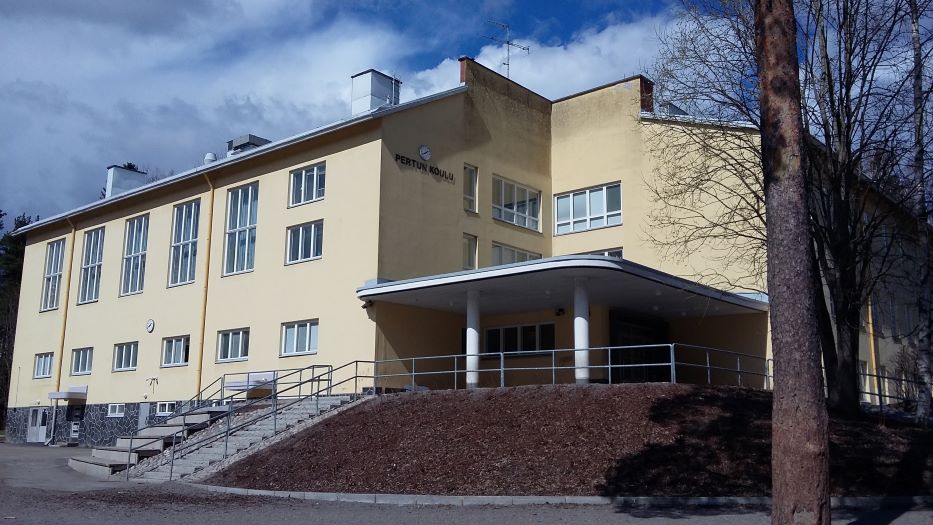
In the 2025–2026 academic year, Pertun School will have 232 pupils in primary education.
Communication with the school
We use Wilma for communication between home and school(switch to another service). The best way to contact teachers is via Wilma.
The email addresses of teaching staff follow the format etunimi.sukunimi@tuusula.fi. See the teaching staff’s full contact details!
School lessons and break times
8.15–9.00 am Lesson
9.00–9.45 am Lesson
9.45–10.00
am Break 10.00–11.00 am Lesson (Years 1–3, including lunch) / 10.00–10.45 am Lesson (Years 4–6)
10.45–11.15 Break (Years 4–6) / 11.00–11.30 Break (Years 1–3)
11.30–12.15 Lesson (Years 1–3) / 11.15–12.15 Lesson (Years 4–6, including lunch)
12.15–13.00 Lesson
13.00–13.15 Break
13.15–14.00 Lesson
14.00–14.45 Lesson
School term dates and holiday periods
Academic Year Plan
The school’s academic year plan is available on Wilma(switch to another service).
After-school club
Pertun School runs an after-school club for primary school pupils. The club runs from 12.15 pm to 4.30 pm on the school premises and in the school playground. You can contact the after-school club on 040 314 3238.
The club’s operating principles and objectives:
The after-school club is child-centred. The children are treated as individuals and are all equal in the club. Discussion and asking the children for their opinions are part of our daily routine. We want to create a relaxed and enjoyable afternoon with the children and make the club ‘our club’. We do crafts and draw, and play is a very important part of the children’s lives. Our aim is to teach the children to be considerate of others. We, the leaders, ensure that there is something suitable for every child in our activities. The planning of the club’s activities is flexible.
The aim of the after-school club is:
- to provide safe, supervised and structured activities for pupils in Years 1 and 2
- enables parents to work
- support the educational work of schools and families
- to make the child feel safe, with an adult present, someone to listen, and a hug if comfort is needed
- teach the child to take care of and take responsibility for their homework
- teach the child to look after their own belongings as well
- teach good manners, teach table manners
- teaches children to be considerate of others and to make friends – friends are not left alone.
Information on the activities and application process for Tuusula Municipality’s after-school clubs can be found on the after-school clubs page.
Pertun School Rules and Regulations
- The purpose of the school rules is to promote order within the school, ensure that learning proceeds without disruption, and foster a safe and pleasant school environment.
- The school rules are based on the law and apply to all school activities throughout the school day, including school activities outside the school premises (e.g. after-school clubs, study trips and school camps).
- These rules apply on school premises throughout the school day, as well as during the break period both before and after the school day ends.
Pupils’ rights and responsibilities
Equality and non-discrimination, and other rights of pupils
Pupils’ rights
- I am entitled to free education every school day.
- I am committed to ensuring equality between the sexes and the rights of linguistic, cultural and religious minorities.
- I have the right to a safe learning environment.
- I have the right to personal freedom, physical integrity and the right to privacy.
Pupils’ responsibilities
- I am required to attend lessons every school day, unless I have been granted permission to be absent.
- I will follow the school rules.
- I will not hurt or bully anyone with my words or actions.
- I enjoy sweets, soft drinks and energy drinks at home.
Safety, comfort and a barrier-free learning environment
Good behaviour
- I work hard in class.
- I always study quietly without disturbing others in the classroom and in other learning environments.
- I eat with good manners.
- Kind regards.
- I dress for the weather.
- I’ll hang my outdoor clothes on the coat hooks provided and put my shoes on the shoe rack in the hall.
Keeping the place tidy and looking after the environment
- I treat school property and other people’s belongings with respect and care. If any damage occurs, I will report it to a teacher immediately.
- I do my bit to keep the school and its surroundings clean and pleasant
- I always put my bike on the rack.
- I eat my snacks tidily outdoors and always put the rubbish in the bin.
Safety
- I will not leave the school grounds during the school day and will stay in the break area. The woods are only part of the break area during the long break.
- Pupils must dress in such a way that they can participate safely in lessons. Teachers will provide more detailed guidance on how to dress during the school day to ensure that safety and hygiene are taken into account.
- I only skate with a helmet on.
- I slide down the slide safely.
- Cycling, rollerblading or skateboarding are not permitted during the school day.
- I don’t throw snowballs in the school playground. I can only throw snowballs at the ball wall in the sports hall.
- You must not go into the ditches during school hours.
The use of computers, mobile phones and other mobile devices (computers, tablets, headphones and phones, as well as smartwatches, smart glasses and other similar devices)
- Mobile phones or other mobile devices (e.g. smartwatches) must not be used during lessons, except where the teacher has given permission for their use for learning purposes, or where the headteacher or teacher has given permission for their use for personal healthcare or as an assistive device.
- During lessons, the use of personal mobile devices is permitted only for study-related tasks and with the teacher’s permission.
- The use of personal mobile devices is prohibited outside of teaching hours, including during mealtimes and break times.
- Pupils must keep their own mobile devices in their school bags during the school day. Pupils must ensure that their devices are set to silent mode (no sound or vibration) during the school day.
- School tablets and laptops must be treated with care and always returned to their designated places to be charged after use.
Alcohol and dangerous items
- I do not carry any dangerous substances or other items unrelated to schoolwork with me. Nor do I bring alcohol, tobacco products or drugs to school.
Discipline
- A pupil who consistently disrupts lessons, breaches school rules, behaves dishonestly or treats other pupils or school staff disrespectfully may be required to attend a disciplinary meeting. The meeting may be held either during or outside school hours (Basic Education Act, Section 35a). The disciplinary meeting is recorded in Wilma.
- A pupil who breaks the school rules may be given detention for up to two hours. During detention, the pupil may be given written or oral tasks which must support their education, learning or development. (Basic Education Act, Section 36). Detention is recorded in Wilma.
- Disciplinary measures include a written warning and suspension from school for up to three months.
- A pupil who disrupts teaching may be disciplined by removing them from the classroom or any other room where teaching is taking place (Basic Education Act, Section 36). The pupil is moved to another classroom to ensure supervision.
- A pupil’s right to education may be suspended for a maximum of the remainder of the working day and, if necessary, the following school day (Basic Education Act, Section 36).
- A pupil who has failed to complete their homework may be required to spend up to one hour at the end of the school day completing the outstanding tasks (Basic Education Act, Section 36). The guardian will be notified in advance.
- A pupil is obliged to compensate for any damage they cause. They are obliged to clean or tidy up any school property that they have soiled or left in disarray. Section 35 of the Basic Education Act. The headteacher will report the matter to the police if a serious act of vandalism or theft occurs.
- Teachers and the headteacher have the right to inspect a pupil’s belongings. The headteacher or a teacher may, if necessary, take possession of disruptive or dangerous objects or substances (Basic Education Act, Section 36). Dangerous objects and substances shall only be handed over to the police.
- The headteacher or a teacher at the school has the right, either jointly or individually, to confiscate from a pupil during the school day any prohibited object or substance referred to in section 29(2) that the pupil is using to disrupt teaching or learning.
- All pupils at the school are required to report to the headteacher or a teacher any incidents of harassment, and, accordingly, the headteacher or teacher is obliged to report the matter to the guardian or other legal representative of the pupil who has committed the act and the pupil who has been subjected to it.
Monitoring and reviewing the rules and regulations
Pupils are given the opportunity to help draw up the school rules
. The school rules are discussed in all classes and can be found on the school’s website.
The rules are reviewed and updated each academic year.
Prevention and investigation of bullying
Pertun School’s anti-bullying plan sets out, among other things, our school’s anti-bullying measures and a procedure for dealing with incidents of bullying.
Supporting pupils
Student welfare work encompasses all activities that support the school day and everyday student life. The school has a Student Welfare Team (OHR), which is a multi-professional working group. The headteacher chairs the Student Welfare Team.
The following staff members are involved in the OHR’s work at Pertun School: the headteacher, a special needs teacher with a broad remit, the school welfare officer, the school nurse, and the class teacher of the class or pupil whose case is being discussed. All classes are reviewed once a year by the pupil welfare team together with the class teachers. Parents are also welcome to discuss matters concerning their own child with the OHR. A time for the discussion will be arranged separately.
The role of the student welfare team is to support high-quality basic education and a positive school experience, to foster a culture that promotes growth and development, and to organise and provide pupils with support related to their schooling whenever it is needed.
School health services
School health care supports the growth and development of children and young people and aims to help shape their values and attitudes in a way that promotes good health. Health checks are carried out on pupils annually, and follow-up visits are arranged as required. If necessary, the school nurse provides immediate assistance to pupils who fall ill during the school day and administers first aid in the event of accidents. However, actual medical treatment is not part of school health care but is provided at the health centre.
School nurse Virpi Liukkonen:
Please contact me via Wilma(switch to another service), by email at virpi.liukkonen@keusote.fi, or by phone on 050 497 0035.
Dental care for primary school children
All pupils in Years 1, 3 and 5 will undergo an oral health check-up and receive a treatment plan at the PopUp dental clinic at the school. Following the PopUp check-ups, a health promotion session will be held for the pupils in small groups. The session will focus on oral hygiene.
In addition, pupils are invited to the dental clinic for oral health check-ups as required.
If a child requires treatment, the family will be informed of the appointment time. Follow-up appointments always take place at the dental clinic. Parents are responsible for taking their child to the dental clinic.
Emergency dental service
The emergency dental service for those requiring urgent treatment (e.g. following an accident or severe pain) operates by appointment and always requires you to contact the central booking service for oral health care on 019 226 0700.
School meals and pupils’ special dietary requirements
Parents are responsible for notifying the school of any special dietary requirements. Please contact the school nurse (contact details can be found under ‘School Health Services’). She will pass on the information regarding the special diet to the local council’s catering services. Please note that the diet can be provided two days after the notification has been received by the school kitchen.
Our school also offers a vegetarian option every day.
Please see the Tuusula municipal guidelines on special diets on the ‘Daycare and school meals’ page.
Leisure and club activities
Schools organise leisure and club activities. Information about these is shared via Wilma and on the school noticeboard. The schools’ activity calendars(switch to another service) can also be found on the council’s website.
Take a look at the activity calendars(switch to another service).
Leisure and club activities are organised on the premises of schools and other organisations, as well as online.
Plans
- The anti-bullying plan at Pertun School is being updated.
- Pertun School’s Equality and Non-Discrimination Plan
- The state of equality at Pertun School has been assessed from the parents’ perspective through the Basic Education Quality Survey for Parents. A survey on equality and non-discrimination was conducted among parents and pupils in Years 4–6 to investigate their experiences of equality at school and within their own class community. A quick survey was conducted among pupils in Years 1–6 to investigate issues relating to pupils’ well-being.
- Based on surveys conducted among pupils and parents, the equality situation at Pertu School is at a commendable level.
- Pertun School does not have specialised classes. Teaching is organised on a local school basis; our inclusion arrangements are one of our strengths, and we have highly developed flexible learning arrangements. In addition, our school runs a regional small group called Steppi.
- In all subjects, pupils are grouped on pedagogical grounds, without regard to gender.
- Support is allocated to groups according to their needs. The composition of the groups is flexible. Integration is strong among the pupils in the Steppi class.
- Pupils are assessed in accordance with the principle of equality.
- We discuss issues of equality and non-discrimination with pupils as part of the school routine. We address inappropriate and disruptive behaviour and language, including through preventive measures.
- Pertun School’s plan to protect pupils from bullying and violence
Lost property
Lost property at our school is collected in the lost property boxes located in the corridors. Please label your clothes! If the clothes we find have a name on them, we will try to return them to the pupil’s coat hook. Any items or clothes found belonging to those using the school in the evenings are also placed on the coat hooks.
The lost property collection point is cleared twice a year for a clothing collection. This takes place after the Christmas and spring parties, so parents should check the lost property collection point no later than at these events.
We take any valuable items found, such as watches, jewellery, keys and mobile phones, to the staff room.
This content has been translated using AI