Information about indoor air
On these pages, you will find information about indoor air processes in the municipality of Tuusula, guides and instructions for users of the premises, and useful links related to indoor air issues.

Indoor air quality issues in municipal premises
Indoor air quality problems in public buildings affect not only municipal employees but also a large group of people outside the municipal organisation, including schoolchildren, children of nursery age, and evening and weekend users of sports facilities and other premises.
The municipality of Tuusula actively works to improve indoor air quality in cooperation with various indoor air experts. The municipality has indoor air guidelines that we follow. This makes our activities predictable, and everyone is aware of the process and its various stages. The indoor air guidelines instruct users of premises and buildings administered by the municipality on the correct procedures to follow.
Standardised indoor air process
If you suspect that you have experienced symptoms caused by indoor air quality in our premises, please report it. The reporting process will depend on your role as a user of the property.
Users of the premises play a major role in property maintenance and maintaining good indoor air quality. We can often eliminate emerging problems and improve the situation with simple maintenance measures. You can download a user checklist from the link below. It highlights the things you should check first if you experience problems with the air quality in the premises.
Our primary aim is to resolve problems through maintenance measures based on user reports. The actual investigation process always begins with a site visit by our facility services experts. During the visit, we check the functionality of the building’s technical systems and other factors that may affect indoor air quality. We repair any defects we find and continue to monitor the situation. If the problem persists despite maintenance measures, we determine the scope and method of further investigation. Once the investigations are complete, our facility services experts will determine the scope of repairs required in accordance with the recommendations provided in the report. Sometimes the problem is clearly identifiable and we can proceed with repairs without further investigation.
If the problem persists and the investigation is prolonged, we can set up a site-specific indoor air working group for the site. The decision to set up an indoor air working group is made by the municipal indoor air working group.
The process from the user noticing an indoor air problem to the completion of repairs is unfortunately long. However, careful investigations and repair plans are necessary to ensure that the repairs are successful.
We can make things easier for users during the process by taking measures to ensure safe use. These measures may relate to, for example, ventilation, pressure control in rooms, increased cleaning standards, sealing repairs, air purifiers and partial restrictions on the use of rooms.
Communication at different stages of the process is also important. We strive to inform property users about upcoming indoor air quality investigations, the results of the investigations, and the different stages of repairs. We are open and do not conceal any information. A site-specific indoor air working group monitors the different stages of the process, if such a group has been established for the site. You can find the indoor air bulletins sent to schools and daycare centres on the Site-specific indoor air working groups page.
Factors affecting indoor air quality
The indoor climate of a building is determined by several inte al and exte al factors. Air quality is significantly affected by ventilation and sources of pollutants. Typical indoor air pollutants include, for example
- mineral fibres
- allergens, pollen and other fine particles
- VOC compounds
- perfumes (hairspray, perfume)
- tobacco smoke
- microbes and bacteria originating from moisture damage
- sewer smell
- radon.
In addition to these factors, other more mundane issues also affect the indoor climate, such as
- air and surface temperature
- relative humidity (dry indoor air, especially in winter and spring)
- air speed (draught)
- cleanliness and standard of cleaning of the premises.
When investigating indoor air problems, all of the above factors must be taken into account. Indoor air problems often consist of many simultaneous factors. The intensity of exposure depends on the size of the source of contamination, its location and the length of time we spend in the area affected by the source of contamination. Investigating these issues is sometimes almost like detective work.
Tuusula is located in a radon area.
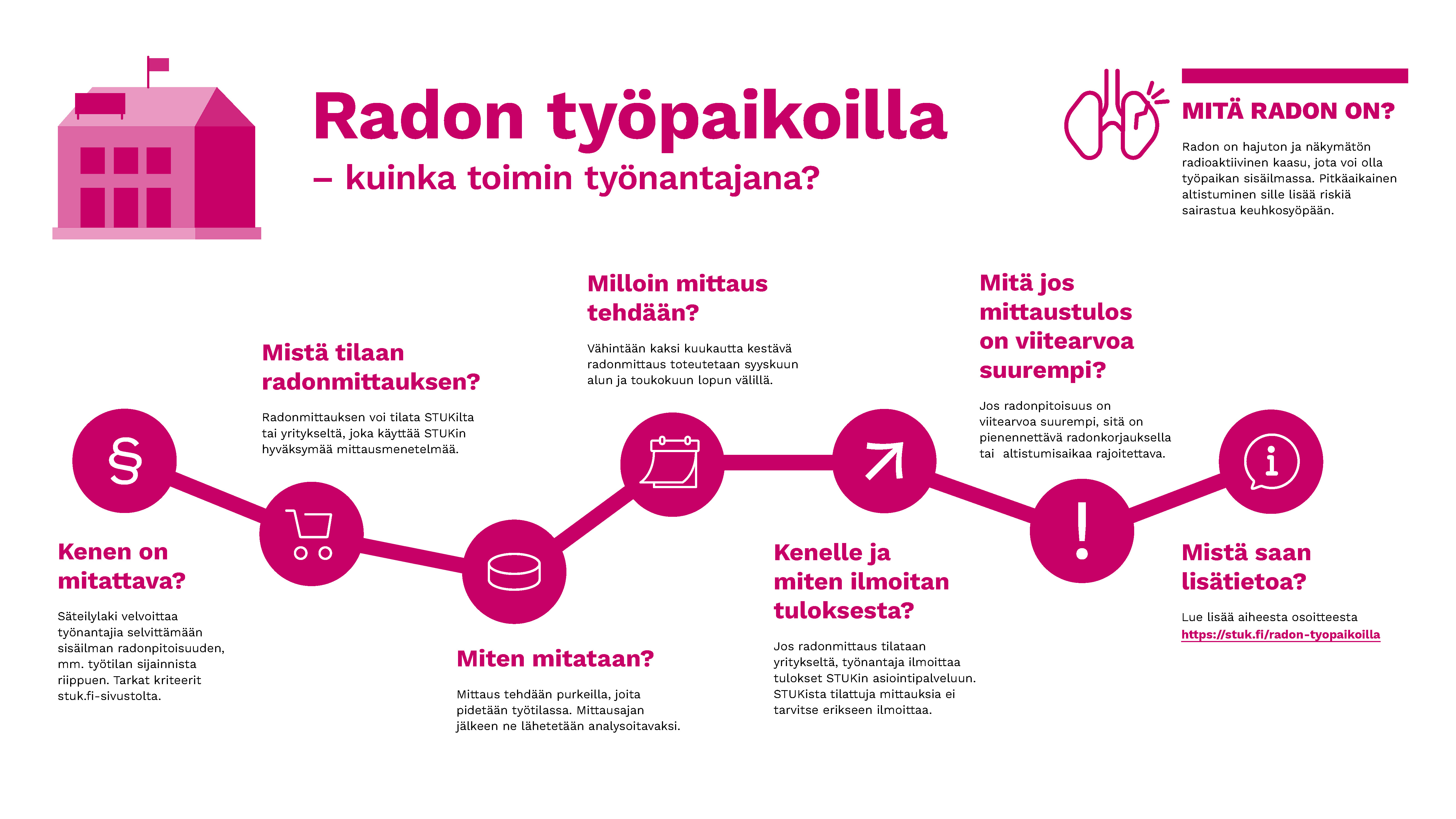
Tuusula is located in an area where radon measurement is mandatory in workplaces. Tuusula continuously measures radon concentrations in its premises in accordance with STUK guidelines. Elevated radon concentrations have been measured in only a few rooms in the entire building stock.
Radon measurements
Measurements are usually taken using radon canisters. The measurement period is from autumn to spring, when radon concentrations are at their highest. The measurement takes at least two months. According to current regulations, the radon concentration in the indoor air of a dwelling or other living space may not exceed 300 becquerels per cubic metre (Bq/m³) of air. However, new dwellings or houses must be constructed in such a way that the radon concentration does not exceed 200 Bq/m³. These regulations also apply to workplaces, schools, daycare centres and other premises where people regularly spend time.
Exposure to radon significantly increases the risk of lung cancer
Radon is an odourless and invisible radioactive gas that can be found in indoor air. Since radon cannot be detected in any way, measurement is the only way to determine its concentration. Radon is produced in the earth’s crust as a decay product of uranium and thorium. Indoor radon concentrations in the UK are higher than in most other countries. The reasons for this can be found in the climate, building technology and soil. Radon migrates from the soil into indoor air through leaks in structures.
Long-term exposure to high radon concentrations significantly increases the risk of developing lung cancer. Indoor radon is the second most common cause of lung cancer in Finland after smoking. In Finland, 15% of lung cancer cases are linked to radon exposure. Smokers are at particularly high risk of lung cancer caused by radon. However, it is impossible to assess an individual’s risk of lung cancer, as it is always the result of many factors and chance. In Finland, an estimated 150–270 people develop lung cancer from radon each year. According to current understanding, radon does not cause any health hazards other than lung cancer. Radon also does not damage foodstuffs stored in high radon concentrations, for example.
For more information on radon, please visit the STUK website via the links below.
The municipality of Tuusula encourages all employers in Tuusula to measure radon levels at their workplaces.
Further information on indoor air
We have also compiled a list of key national indoor air actors, programmes and projects, whose websites provide a wealth of information on indoor air from different perspectives. Read more about indoor air issues via the links below.
The Housing Health Regulation sets out the health conditions and action limits for dwellings and other accommodation facilities, such as schools, daycare centres and social welfare units. The reference values set out in the regulation ultimately guide our activities.
The Organisation for Respiratory Health in Finland compiles information on common indoor air challenges and advice on how to remedy them on its website.
The Indoor Air Association provides you with impartial information about indoor air.
The aim of the Healthy Premises 2028 programme is to improve the healthiness of public buildings and enhance the treatment and rehabilitation of people suffering from indoor air-related symptoms. During the ten-year programme period, a property management approach will be established in which the condition of buildings, their suitability for their intended use and user experiences will be regularly checked and evaluated. The programm ended exceptionally in 2025.
The National Indoor Air and Health Programme 2018–2028 consists of four areas, the aim of which is to increase understanding of the healthand well-being, developing the management of indoor environment-related problems, improving the treatment of people with symptoms and illnesses in indoor environments, as well as their ability to work and function, and strengthening the expertise of actors in indoor environment matters.
The aim of the Satakunta project is to improve the condition of the built environment using the latest research-based methods and to maintain the condition and value of properties, as well as the health and safety of buildings, through timely repair interventions:
The aim of the Let’s Solve It Together project is to help municipalities find solutions to support children and families when indoor air quality at school causes symptoms:
Ventilation of business premises
Ventilation plays a major role in indoor air quality. Properly dimensioned and functioning ventilation replaces the air in rooms quickly enough and at the same time removes impurities and odours, whether they originate from the building or its users. In addition to sufficient air volumes, the temperature and distribution of the air supplied to the premises are also important.
So, make sure that the ventilation in the classroom or office is on when people are working in the space, and that there’s no extra stuff blocking the air vents that could stop the air from moving. Also check that your workstation is not located in a storage room or other space with no ventilation. Such spaces are not intended for continuous work.
In accordance with the Tuusula municipality’s operating model, ventilation is continuously on in all municipal properties. Depending on the property and ventilation equipment, ventilation can also operate at partial power if this achieves sufficient air volumes.
Ventilation is not very helpful during hot weather
The majority of office buildings in the municipality of Tuusula do not have air conditioning, which means that indoor temperatures can rise significantly on hot and humid days. The situation will only improve when the days become cooler. On hot days, we recommend closing the curtains and windows. Personal well-being should be taken care of in accordance with occupational safety regulations, among other things. Here are some guidelines for space users to minimise unnecessary heat load:
- Close the windows and blinds during the day.
- Switch off unnecessary lights.
- Switch off unnecessary electrical equipment, such as computers and projectors.
- Dress appropriately for the weather.
- Drink plenty of fluids and ensure you are getting enough nutrition.
Many people hope that increasing ventilation during hot weather will lower the temperature. Here in Tuusula, ventilation is already running continuously day and night. During the day, the ventilation system brings warm outside air inside, so simply increasing the amount of air is not the solution. At night, ventilation brings cooler air inside, but as the outside air warms up during the day, the indoor temperature also rises quickly.
Due to longer periods of hot weather becoming more common, there is a constant search for ecological and cost-effective cooling solutions for existing buildings. Mechanical sunshades can be used to create shaded areas in school and nursery playgrounds, providing shelter from the sun for children and adults enjoying the outdoors. At the same time, they shade the buildings, reducing the heat load on the interior. Window films and awnings also reduce the impact of solar radiation inside buildings.
New buildings are usually equipped with air conditioning, which makes it easier to control the temperature inside. However, even in these buildings, it is important to close the blinds and windows during hot weather so that the benefits of air conditioning are not wasted.
In freezing temperatures, the air is dry and stuffy.
In many buildings, ventilation is used at partial capacity during severe frosts because the heating capacity of the ventilation units is insufficient to heat the incoming air at full speed. In practice, the operating speed of ventilation units automatically drops to partial power when the outside temperature falls below -11 degrees Celsius. This can cause a feeling of stuffiness when there are many users in the premises.
Another problem during the cold season is dry indoor air, which is a result of the low absolute water content in the outdoor air. Dry air is a particular problem in schools and daycare centres, where mechanical ventilation is highly efficient. The relative humidity of indoor air can be less than 10% in severe frost. Dry indoor air causes and exacerbates irritation of the respiratory tract, mucous membranes of the eyes and skin. Personal humidifiers are unlikely to have a significant effect on room humidity, and the devices may do more harm than good.
Both problems will only ease when the frost subsides.
Indoor air conditions in buildings monitored in Tuusula
Indoor air conditions, such as temperature and relative humidity, have a major impact on perceived indoor air quality. Pressure differential monitoring allows us to determine whether ventilation is working as designed. We monitor the indoor air conditions in our properties either through the building’s own automation system or by using separately installed condition and pressure difference sensors.
Through continuous condition monitoring, we aim to detect faults in ventilation and heating systems before they cause problems.
This content has been translated using AI