European Mobility Week encourages people to consider alternatives for getting around in their daily lives
Take a look at the content of this themed week and pick up some tips on how to get more exercise in your daily life!
What is European Mobility Week?
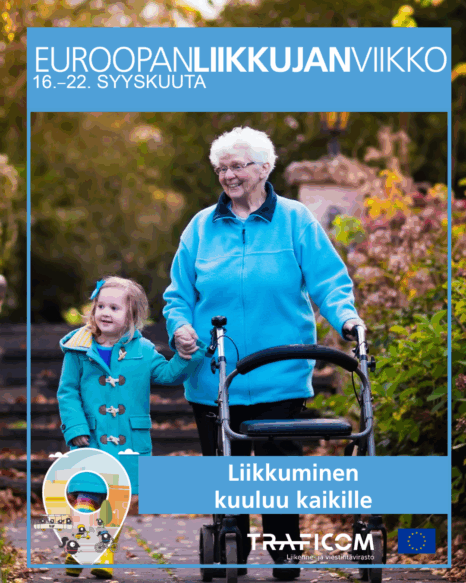
European Mobility Week is held every year in September, from 16 to 22 September. Mobility Week encourages people to reflect on their everyday travel choices and their impact on the environment, society and health. The aim of the week is to encourage active travel, the use of public transport and other sustainable transport solutions.
European Mobility Week concludes with the now-traditional Car-Free Day on 22 September. Car-Free Day encourages people to try cycling to work or using public transport wherever possible.
Mobility is for everyone
European Mobility Week continues with the theme from last year: ‘Mobility is for everyone’. This year, the theme is being examined specifically from the perspective of intergenerational equity. Mobility needs and opportunities vary at different stages of life. Transport systems must therefore be accessible, safe and functional for everyone. At the same time, it is important to develop solutions that stand the test of time and support well-being well into the future.
When it comes to older people’s mobility, conditions must be particularly favourable; for example, a sufficient number of benches to rest on whilst walking, as well as well-cleared and gritted footpaths in winter, reduce the barriers to older people getting out and about. Children and young people need encouragement from all adults to walk short distances, whilst adults might consider whether it is really necessary to drive children around. For people of working age, alternatives and opportunities must be provided – for example, for journeys to and from work – to make getting about meaningful.
Everyday journeys are an opportunity to get more exercise
By covering your everyday journeys under your own steam, you’ll be incorporating physical activity that’s beneficial to your wellbeing into your daily life. A walk to the shop and back, for example, easily counts as a short jog in terms of the number of steps. By cycling to work, even on a busy day, you can rack up the recommended amount of physical activity without having to set aside time specifically for exercise. Research has shown that active transport has health benefits, but the environment also benefits when journeys are made under your own steam.
However, it is not always possible to cover these distances on foot or by bike. In such cases, public transport offers a more active alternative than a private car, as journeys usually involve walking to stops and between connections. Studies show that public transport users accumulate an average of 10–30 minutes more everyday physical activity per day than those who use private cars. Even walking journeys that seem short can therefore significantly increase the number of steps taken over the course of a week.
Encouraging children and young people to be physically active
In Tuusula, physical activity and an active lifestyle are promoted in the environments where children and young people spend their daily lives. It is recognised that increasing physical activity during early years education, pre-school and school hours can contribute to children’s wellbeing and, above all, support physical activity among children who are less active. Furthermore, the legislative amendment on promoting an active lifestyle introduces new approaches and models for increasing physical activity during school days, continuing the long-term ‘Active School’ initiative, which has become an integral part of school life.
However, many schoolchildren do not get enough exercise during their journeys to and from school and in their free time. According to the 2025 School Health Survey, 59 per cent of Year 4 and Year 5 pupils in Tuusula and 69 per cent of Year 8 and Year 9 pupils do not get enough exercise to meet the recommended levels. By increasing active travel on the way to school, children and young people will get more regular exercise and get into the habit of being active when travelling short distances in their daily lives from an early age.
Schools and early years education centres are encouraged to organise activities in line with ‘Active Week’ within their own settings. The guide available on the ‘Fiksusti kouluun’ website provides resources and tips for education professionals on how to organise events for the themed week:
Choose the tip that suits you best from these for Active Week:
- Even a daily walk of just half an hour can improve your cardiovascular fitness by 10–15 per cent in just a few months. See for yourself how a 30-minute walk makes you feel.
- 75 per cent of all journeys made by Finns each day are less than 10 kilometres long. Think about your own everyday journeys. What sort of distance could you cover by walking, cycling or using public transport? Give it a go as soon as you can.
- Make sure you have the right kit for being outdoors. Whatever the weather, you can get out and about if you have the right clothes and kit, and you won’t get wet if an autumn shower takes you by surprise. Have a quick check – is your outdoor gear in good condition in your cupboard?
- You can make your car journeys more efficient by giving a lift to people travelling in the same direction – for example, to work or to their hobbies. Why not ask a friend for a lift as early as this week?
Further information:
This content has been translated using AI